Thursday, April 21, 2011

The Smart Security Grid

One of the biggest issues of the modern day is, without a doubt, energy. We are obsessed with how to use less and generate more of it, or at least take what we have and use it more efficiently. The Obama Administration has noticed this (of course), and expanded the American Recovery and Reinvestment Act to provide for the development of new electric grid technology, which holds the key to advanced energy management and pecuniary savings. Because it is such a large undertaking, the project also promises job creation and energy independence. But this sounds too good to be true, so what's the catch?

The downside to a giant grid is lack of security. The grid is obviously an interconnected web of networks that would be extremely vulnerable to attack from hackers and worms in the system, and because it would be such a central part of how the country runs itself, any attack could result in a massive loss of electrical services. Attack isn't the only downside to a large grid; this kind of project has never been done on such a large scale, and there are definitely unforeseen problems in putting so much energy into one place.

Even if all these disadvantages are disregarded for a moment, there is still the problem of how to run the grid itself. With so many different utilities, providers, and consumers scattered across it, the need for a consistent operating system is imperative. Which system should be used? Experts are still working on that one, and it's not as easy as it sounds. Even if a framework was agreed upon, it would almost immediately have to be updated because of the rapid pace at which technology in general changes. The grid would need to evolve itself constantly to keep pace with demand.

In order for this project to be worked out, the general public of consumers must be educated about what this change could mean for themselves. Many times we will just see the good of a situation and blind ourselves to the bad. "Oh, better energy management? Sign us up!" we might be tempted to say, but the truth is that this issue is about more than reducing our carbon footprint. We might end up paying more (in dollars) for the giant energy grid, but because no one wants to pay more for something they already have, the majority of people might not even bother to switch. And that's not even considering the omnipresent issue of a lack of a generalized framework and cybersecurity network in place yet.

Do you know how much information your energy provider has about you? The answer is a lot. Any hacker or worm good enough to crack into the (currently) weak security system in an energy grid could access your information easily and quickly, and because energy companies are extremely wary of sending out any information about security attacks, you might not even know until it's too late.

This is a rather serious post this week about the dangers of technology, but it's here to highlight the need to understand all sides of an issue before we commit to something on a grand scale. Lesson of the day: do your research.
Monday, April 11, 2011

A New Force To Be Reckoned

Last week physicists working at the Tevatron Accelerator at the Fermi National Accelerator Laboratory in Chicago, Illinois, may have encountered the greatest discovery in modern physics since the Manhattan Project during WWII. That new discovery could create quite a stir for particle physicists everywhere, mostly because this "new" particle was wholly unexpected. No one even knows what it is, and because of the sheer surprise of the data, some question its legitimacy. The scientists who ran the experiment estimate its potential error at less than .25% probability, but it's still not enough to publish a hard-core report. Assuming the data are real, this discovery introduces more problems than it solves: Why didn't anyone predict its arrival? How does it fit in with our idea of the atomic model? What is it?

Current speculation of this particle's identity is a variant form of the infamous Higgs Boson, which scientists have been hoping to view in a collision since its proposed existence in the 1990s. The Higgs Boson is theorized to be responsible for the mass found in other particles, and since any freshman physics student knows that energy can never be created or destroyed, the discovery of the Higgs Boson will elucidate the beginning of the universe and show scientists how mass came to exist.

Cool, right?

Of course, with so many different physicists from all over the world working on this project, there are many alternate theories as to what this could be, one of which is that this is a new physical force which works only a very small distances, such as the strong nuclear forces that holds atoms together. Yet another theory is that we have constantly missed something in our hazy understanding of physics, and this is the first clue as to what that "something" is. If this is true, it could have major implications in a major issue in today's physics: how to unify the theory of quantum gravity.

Because the data are so small and, as of now, unsupported, more tests are absolutely essential in the study of this new particle (or force, or representation of a model heretofore unknown). Unfortunately for every particle physicist on earth, the Tevatron is going to be shut down sometime this year, as late as September and as early as when FermiLab runs out of funding money. If allowed to run this same test again, the FermiLab group would have about four times as much data to analyze, enough for either a refutation or a proposal.

So maybe with all the new cloud computing software going into effect, the Government will be able to spare that money and give it to the scientists at Tevatron. Who knows? This could be the dawn of a new age in particle physics.

Tuesday, April 5, 2011

Adobe Design Achievement Awards

Like any company who produces excellent work, we too like to receive credit and admiration for our work. This is especially the case for the project we have been working on until very recently. Because it is a system bought by Johns Hopkins Medicine, and therefore its property, the actual project cannot be described here; however, we are still able to get credit through the Adobe Design Achievement Awards (ADAA).

ADAA is a competition sponsored by Adobe (the guys who wrote Flash and make PDFs for you) that will award a grand prize of $3000 to the winning individual or team, along with thousands of dollars worth of Adobe products and the recognition of having won. The finalists are flown to Taipei to present at the International Design Alliance, and it is in Taipei that the winner will be chosen. Congratulations Hopkins, your STS team has entered into this contest!

The best part is that anyone who has an idea and executes it has the ability to enter this contest. The rules are that you be a registered student at an accredited institution, the work is your own (and only your own, unless you include all the members of a team), and that out of all the tools you used to create it, half of them are Adobe systems.

There are 15 categories to choose from, although only 12 are feasible (unless you are a teacher, then you have all 15). These categories range from photography and video to browser-based design and new game ideas. The point is that anybody, given a specific amount of free time and access to Adobe products, can enter this competition.

There are three waves of entry submission dates, the first of which has already passed. The next deadline is on April 29, and the final wave starts on April 30 and ends on June 24. If you'd like to be creative and possibly win a trip to Taipei, work on a project in the month after school ends and try your luck!

We are very happy with the end result of our project and hope for the best. Good luck to all!

Tuesday, March 29, 2011

Linux Operating System

When you turn your computer on, you may not be aware of the large amount of communication going on inside of it. A lot of the communication that happens has to do with the operating system (OS) installed on the computer and the applications you might be running. The basis of an OS is software consisting of data and programs that is used to relay information between the hardware and applications. Any computer, including video game consoles and cellphones, uses some type of OS, whether it be Unix, Microsoft Windows, Mac OS X, and, our topic of today, Linux.

Linux first made its debut at the hands of Linus Torvalds in 1991, a then-21 year old Finnish student at the University of Helsinki. Torvalds wrote the Linux kernel so that it would be the first free and open source OS for computers, in contrast to the older Unix and MINIX operating systems. Unix and MINIX both restricted the use of their codes, limiting it only to academic institutions and businesses, with MINIX used more to teach students about OS than for its useful execution outside of the classroom.

The kernel of an operating system is the link between applications on the computer and the hardware, specifically the CPU, memory, and devices. The Linux kernel was first written in the programming language C, but it has been expanded to work with almost any other programming language, including C++, Java, PHP, Python, and Fortran. It is a monolithic kernel, which means that executes all the operating system code in the same address space to increase the performance of the system.

Linux is mostly used on servers, which is how Linux ended up running the 10 fastest supercomputers in the world, but its popularity on desktops has increased in recent years, possibly as a result of a 2007 "rebellion" in the Linux development community. As a result, many applications that used to run on only Windows or Mac OS have now been "translated" to Linux, including popular games such as World of Warcraft and Team Fortress 2, and more mundane applications such as Mozilla's FireFox internet browser.

However, if you're the kind of person who likes to look at code, the prospects for the Linux market are growing rapidly. The latest version of the Linux kernel is about 13 million lines of code, and with the ever-present advances in technology, the next one will be longer and more complex. Linux is definitely something to watch for and understand in the world of computing and technology.

Tuesday, March 15, 2011

The Switch to IPv6

Forget 2012, because it's 2011 that is the end of the IPv4 world in which we've all grown up. The Internet Assigned Numbers Authority, the organization which controls and coordinates global IP addressing for every computer on earth, is running out of IPv4 (stands for Internet Protocol version 4) addresses. As of February 2011, it was down to the last 2.7% of them.

So does this mean that new computers will become unusable? Of course not. The solution for this problem involves a little creativity, and a lot of new space.
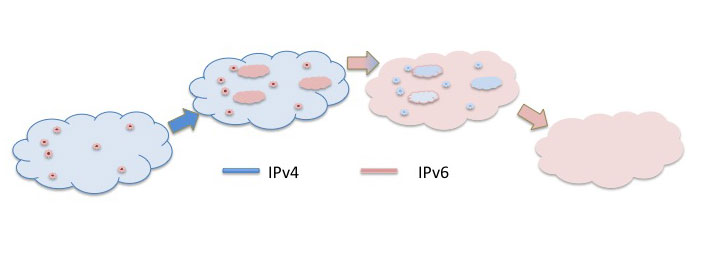
The gradual transition to IPv6. From http://www.potaroo.net/ispcol/2008-09/fig1.jpg
 To explain this better, imagine that all the IPv4 addresses are like the apartments in New York City. There's a limit to how many there are, and once they're filled, they stay there for good. Any technology device, including printers, has an IP address to tell other computers where to direct their information, similar to the mail service when you want to send a letter to a friend. Unlike people, however, the computers never change their addresses, and so this had led to the problem equivalent to overpopulation. So, instead of deleting computers from the system, computer scientists have been building New York City 2.0, which they have called IPv6.

IPv4 is a 32-bit internet layer protocol which handles the transfer of information through "routes," or pathways on the internet. Every piece of information shared online has three core data points that direct it: who sent it (IP address 1), where it's going (IP address 2), and how it's getting there (the route). This system was created in the 1980s, far before the internet got so huge, and long before anyone predicted it would run out. After all, it accounts for 2^32 addresses! Side note: remember that computers use a binary (base of 2) system to communicate.

IPv6, on the other hand, is a 128-bit internet layer protocol which can support 2^128 addresses, which is about equal to the impossibly large number 340 undecillion (3.4 x 10^38). This expansion allows for many more devices and users on the internet as well as extra flexibility in allocating addresses and efficiency for routing traffic. As of now, IPv6 is still in the pilot stage, but on June 8, 2011, this will change. Why? It's World IPv6 Day, of course!

On that day, the entire globe will be undergoing a test of the major IPv6 infrastructures. Many of the most commonly used websites (Facebook, Google, etc.) have or will enable a "gateway translation," which will allow IPv4 users to connect to IPv6. Unfortunately, .05% of people who are covered by IPv4 will experience major technical issues on this day. These are the problems that World IPv6 Day is trying to fix before the entire IPv6 is launched full-scale, which might happen in a decade or so.

So don't worry about losing internet access yet, unless you are part of the .05% group who has issues with the switch to IPv6. The point is that it's out there, and we're ready.

To all Johns Hopkins students, have a safe, restful, and fun Spring Break. The blog will return in 2 weeks. Until then, enjoy this small joy.

Wednesday, March 9, 2011

Cloud Computing Part 2: Applications

So a major question you should be asking right now is: Why are we so worked up about cloud computing now if it's been around and in use for a couple of years already? There are two answers to this question. 1) Microsoft has now become a cloud supplier, and since they've been doing a lot of advertising about it lately, the idea has finally reached the public's ears.

The second reason is far less fickle than the public's attention: The Obama Administration has asked agencies to cut the number of federal data centers by 40% in five years and identify 3 applications to move to a cloud in the next 18 months, one of which must be moved successfully in only 12.

This means that the U.S. Government will be on clouds (and servers) which could potentially be accessible by anyone. Obviously there's an issue with confidentiality, but ever since WikiLeaks went live, transparency in the Government is sky high. Now, they decided, is a good time to switch to cloud computing, and for a number of different reasons, one of which is cost effectiveness. Because cloud computing is mostly cheaper than owning multiple copies of the same software, the United States Government is cutting their technology budget, however marginally. This doesn't mean that taxes are going down anytime soon, but it does mean that the deficit won't be as large as it would have been without the cloud.

The question that the Government is now asking is which cloud provider will best meet their needs. The General Service Provider (GSA) is the odds-on favorite (mostly because it's also controlled by the Government) for most departments, but since each department is run individually, the choices will be varied. Some may choose public cloud providers such as Amazon or Salesforce, and some may even choose Microsoft.

The most technically-savvy of the departments will use their own cloud because they are equipped with the infrastructure and tech support to have it. For example, NASA's cloud, nicknamed Nebula, is an open-source cloud computing service specifically designed for NASA scientists and data processing. The Department of Energy (DOE) will be using its own Magellan program due to the specificity needed for their research problems, and the lack of this technology on public clouds.

Other, smaller municipalities are heading in this direction as well. New Mexico is looking to reduce IT and electricity costs with cloud computing, and in 2010 New York City made a deal with Microsoft for a single, citywide license under which the city will pay only for the applications that city employees actually use.

So the next time someone says you have your head in the clouds, retaliate by saying "That's where all the information is." You wouldn't be lying either.

Wednesday, March 2, 2011

Cloud Computing Part 1: Basics

To the cloud?

That's where everyone, from commercial users to large companies to the United States Government, seems to be going. Although the concept of cloud computing is relatively new, it has impacted the way we all think about data storage and program use, even if you have no idea what it is. You are not alone in this oblivion; until yesterday, this blogger had no idea what cloud computing was, but I knew I needed to find out.

This is precisely the reason that this week's article is about cloud computing: few people have a clear idea of what it is, but it's about to change everything about how we work with others.

http://tomlambert.com/cloud-computing-will-rule-the-world/
Cloud computing is best thought of as "pools" of computer resources and data storage in which each pool is run by an individual, major company, such as Google or Microsoft. The programs offered by the company will be accessible to every computer in the cloud, just as it is now on the internet or through software installation, but the best part is that you don't need to buy individuals resources and there are no compatibility issues. Essentially, the hardware itself becomes virtualized. Continuing with the pool analogy, it's more like renting a kick-board or flippers in the pool instead of buying your own. This greatly reduces the cost of operating large (and small) businesses, one of the benefits of cloud computing.

Yet another useful feature of the cloud is that any computer within the cloud can be accessed by another computer (hopefully with a password of sorts to prevent any kind of unauthorized access). Aware of the security breaches this kind of openness would cause for its users, the companies who create and maintain the clouds are extremely careful and sensitive to any kind of problem. While these systems seem prime targets for attack, companies recognize this and take extensive measures to prevent it from happening.Specialized teams at cloud headquarters act as highly observant lifeguards on the edges of the pool, ready to jump and save any piece of data that's in danger. In truth, even if a malicious person wanted to bring down the entire cloud cluster, there are so many nodes (sources of data) that it would take far too long for him to succeed.

One of the best parts of the cloud is the almost-endless data storage. While users pay for the ability to store data on a cloud, it's actually a better investment than having multiple back-up files on flash drives and external storage units. Even if you have multiple computers, the cloud will make it so that you have multiple machines, with their files and their programs, on the one computer you are using at that moment.

The layers of a cloud
To gain access to a cloud, first you need to purchase it from a vendor, which could be Microsoft's Azure, Google's App Engine, or any other one not mentioned here. It is a matter of best fit for you and what you need to be able to do on the cloud. Your computer, the client, is able to interact with the application on the cloud in the same way you, as a human, interact with your computer's normal (not cloud) programs. The platform works with the cloud's infrastructure, and controls the deployment of programs, minus the cost and extensive tech support. The infrastructure is the cloud itself, and it varies for each cloud's operating system, but the overall goal is to connect it to a massive server, which is where the data and programming is stored. These are maintained at buildings far away from where your computer is, so you don't have to worry about it at all.Although there are certain parts of each level which interact with each other, the majority of the information is trapped in one layer, minimizing the potential for security breaches and system downtime. The clouds are so effective that it is successful and operative 99.999% of the time (which means it's down for about 31 seconds every year).

Overall, the cloud seems to have so many benefits that even the Obama Administration has declared that the number of federal data centers will be cut by 40% in five years (about 420 of them in total), and that various agencies "identify applications to move to the cloud within 18 months," according to Government Computer News magazine. There will be more about this in next week's blog article. As for now, you've been inundated with enough cloud information.

Special thanks to Eric Caruso of Brown University for his help in explaining to me (in simple English) what a cloud is.